

Every punch item and RFI numbered, owned and pinned on the plan
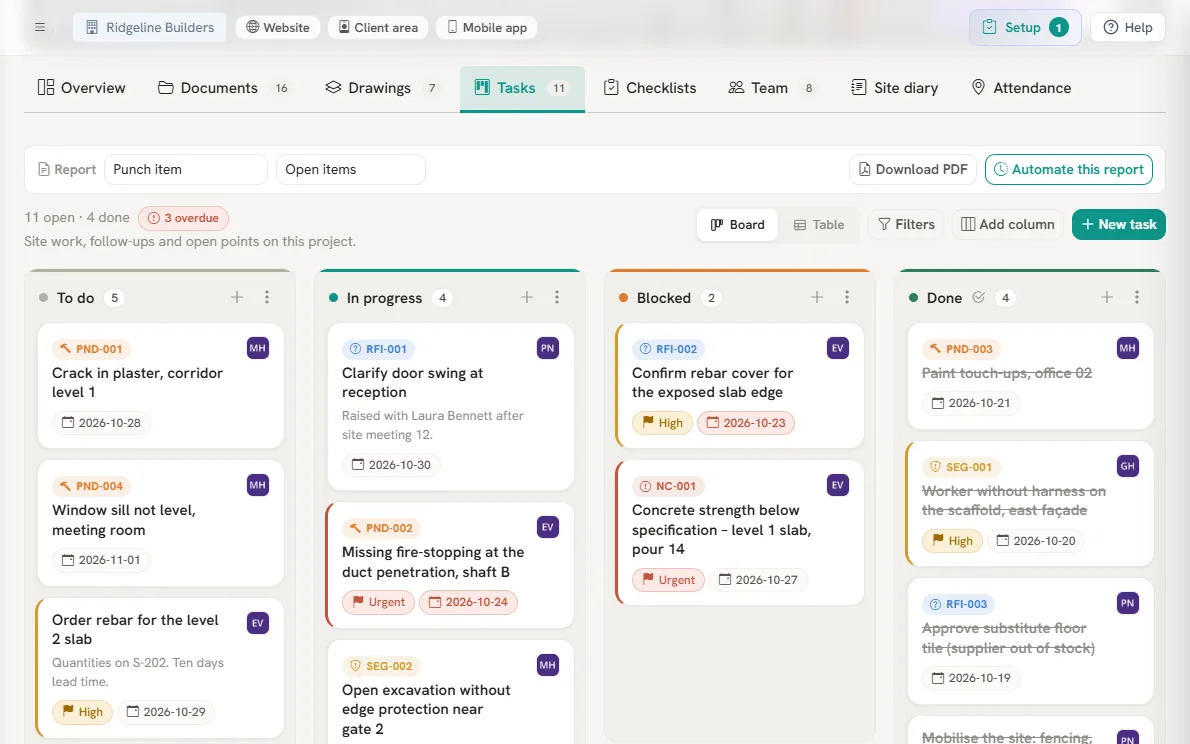
Log punch items, RFIs, non-conformities and safety observations with a photo, a place, a responsible company and a due date. Each one gets its number and follows its own steps until your team closes it.
- Numbered by kind on every project
- Logged on site, even without signal
- Pinned on the drawing
The problem it solves
On many sites the punch list lives in a notebook, the RFIs in email threads and the photos on someone’s phone. Nobody can see which items are late, the subcontractor says it was fixed, and every week someone rebuilds the register by hand for the client.
What it does
Numbered by kind on every project
Punch items, RFIs, non-conformities, safety observations and submittals each have their own numbering per project, so PND-012 or RFI-004 reads the same on the list, the board, the drawing and in emails.
Logged on site, even without signal
On the punch walk the app opens the camera: one photo, one spoken or typed line, the place and who fixes it. Without signal, items wait on the phone and go up when the connection comes back.
Pinned on the drawing
Click the spot on a sheet to create a punch item right there. Open items move onto the next revision of the drawing, and the pin turns green once the item is closed.
Registers as PDF or by scheduled email
Pick a kind and open or all items, then download the register as a PDF with totals, fields and up to three photos per item, or email it on a schedule, such as the open punch list every Monday.
Why it matters
The subcontractor fixes, you verify
A punch item goes from open to fixed to verified: the responsible company marks it fixed and your team verifies it or sends it back. Closing it is up to your team.
What is late, on every project
Tasks across projects shows what is open, overdue, due this week and awaiting verification on every project you are on, with one bar per project showing where attention is needed.
A register ready to hand over
Give a subcontractor, the client or an inspector the current register without retyping anything: the PDF is built from the cards as they stand today.
Frequently asked questions
Can subcontractors update their own punch items?
Yes. Name the responsible company on the item and its people see it and act on it: they answer, send photos and mark it fixed. Your team verifies and closes it.
Does the punch list work without internet on site?
The punch walk in the app does: items wait on the phone and go up when the connection comes back. The other screens need a connection.
Can I send the RFI log to the client every week?
Yes. Pick RFIs in the report bar and use Automate this report to email the register on a schedule, or download the PDF whenever you need it.
Tailored plans
Your proposal is built in the demo, based on the size of your operation.
More features of MotionHub Construction
- Kinds of card and workflowsRFI, punch item, non-conformity, safety observation: each kind with its own fields, numbering and status flow, drawn as a diagram with who may take each step.
- Inspection checklistsQuality inspections, site safety inspections and material receipt checks from templates, with notes, photos and a PDF ready to sign.
- Site diaryThe daily site report with weather, crew, equipment, work done and photos, crew check-in from the phone, and a closed PDF ready to sign.
- Progress photosFixed photo points shot every week from the phone: slide through the dates of each point or compare two photos side by side.
- Projects on a mapEvery project on a map, in cards or in a list, with its status, phase, open tasks and documents waiting for approval.
- Project overviewOne page per project: phases and days left, what needs attention, the site, the client and the team, with every tool of the project one click away.
- Companies and contactsSubcontractors, suppliers, designers, clients and inspectors with their people, invited to each project with or without a licence, or sent documents by transmittal.
- Document registerFolders and versions per project, approval workflows, side-by-side revision comparison and transmittals with a record of who opened what.
- Document approvalsISO 19650 approval workflows and one My approvals queue with every document waiting for you, in every project, one click per step.
- Drawing registerEvery sheet with its number, title, discipline and revision, read from the title blocks of the PDFs, with the open punch items on each sheet.
- Drawing markup and commentsArrows, boxes, revision clouds, text, measures and areas to scale, and comments pinned on the drawing that the team replies to and resolves.
- 3D models and BIMIFC, GLB, STL and OBJ models opened in the browser, with sections, measures and comments, and versions and approvals like any document.
- Schedule (Gantt)A Gantt with dependencies, the critical path and a baseline. Change a duration and every date after it moves.
- Every activityEach activity says what it waits for, who does it and where, and its real progress: actual start, actual finish and percent done.
- Look-aheadThe next 2 to 6 weeks for the site meeting: what starts, what is late and who does it, as a PDF or a weekly email.
- DelaysEvery day the system checks the project’s records and suggests delays with their cause; you confirm them and see the days you can claim.
- Budget and cost reportThe budget by cost code, with subcontracts, purchase orders and bills against each line, and the forecast, variance and margin.
- Change ordersEvery change numbered, with its cost, its price to the client and the days it adds; once approved it moves the budget and the contract.
- Progress billingEach month’s measurement starts from the progress recorded on the schedule, with retention, and becomes an invoice with a due date.
- EquipmentMachines, tools and vehicles: which site each one is on, who has it, the next service and the rentals ending, with QR labels.
- Building assetsLifts, pumps, panels: every asset from purchase to handover, with what is still missing at each stage and a COBie export.
- PlacesThe project’s buildings, floors and rooms, set up once and shared by punch items, checklists, building assets and the schedule.
- Client reportA weekly report that prepares itself with progress, time, photos and the measurement. The client opens it on the phone, asks questions and approves the measurement.
- Handover and owner’s manualEvery unit with its owner and handover date, and an owner’s manual they open from a QR code, with documents, warranties and what to look after.
- Warranty requestsThe owner opens a request from the manual and follows it from a link; your team sees if it is in warranty, which system and which company answers.
See the solution in your company.
Guided demo and commercial terms set per company.