

Your own RFI and punch list workflows, drawn as a diagram
Decide what an RFI, a punch item or a non-conformity asks for, how it is numbered and which steps it follows. Draw the steps, then say who may take each one and what it needs before it moves on.
- Fields built for each kind
- Status flows drawn as a diagram
- Who may take each step
The problem it solves
Every construction company runs its RFIs and quality checks its own way, but most tools impose one fixed form and one fixed set of statuses. Items then close without a check, subcontractors close their own work, and nobody can say who was supposed to answer.
What it does
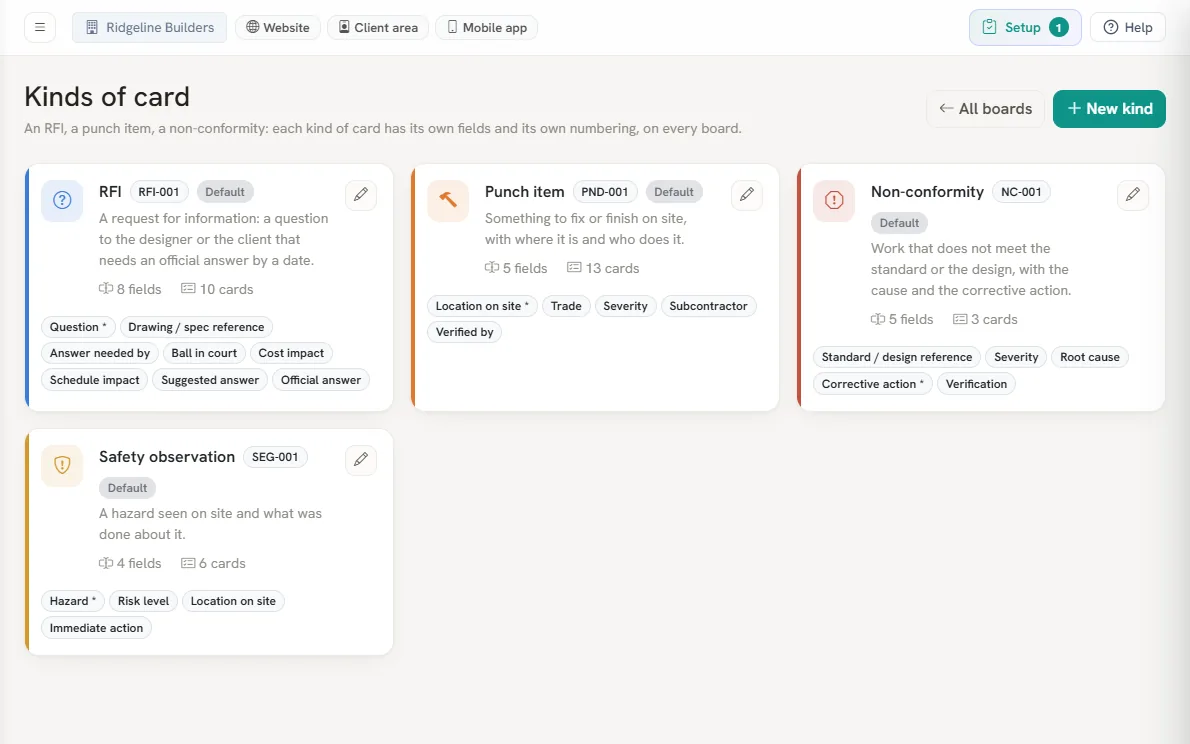
Fields built for each kind
Drag text, number, date, list, choice, person and yes or no fields onto the card, and split a long form into tabs. Each kind has its own numbering prefix, icon and colour.
Status flows drawn as a diagram
Click a step to set its name, colour, board column and the days allowed there, or draw a move to another step. Start from a template or duplicate a flow you already use.
Who may take each step
Each move says who may take it (people, outside companies, groups or roles such as the responsible company) and what it needs first: a comment, a photo, a file or a field like the official answer.
Task pages in every project menu
Group the kinds into pages such as RFIs, Submittals, Punch list or Quality and safety, and each one shows in the project menu with its count of open items.
Why it matters
Closed only after your check
With the ready flows, a card closes only after your team verifies it, and outside people cannot close an item, not even one they raised.
Problems flagged as you design
The designer points out a flow with no final step, a step nothing reaches, a step with no way out or a move anyone may take, before you save it.
The next person knows it is their turn
A move can hand the card back to whoever raised it or to the responsible company, and tell people by email and push.
Frequently asked questions
Can we create our own kinds of card?
Yes. Add a kind with its name, numbering prefix, fields and status flow, and put it on the task page where your team expects to find it.
What happens to existing cards when a workflow changes?
If several kinds share the workflow, you are warned before saving, because the cards of all of them follow the change. To change one kind only, make a copy of the flow for it.
Can a step require a photo before the card moves on?
Yes. Each move can ask for a comment, a photo, a file on the card or a field filled in, and the card says what is missing when someone tries to move it.
Tailored plans
Your proposal is built in the demo, based on the size of your operation.
More features of MotionHub Construction
- Punch items and RFIsNumbered punch items, RFIs and non-conformities with photo, responsible company and due date, pinned on the plan and logged on site even without signal.
- Inspection checklistsQuality inspections, site safety inspections and material receipt checks from templates, with notes, photos and a PDF ready to sign.
- Site diaryThe daily site report with weather, crew, equipment, work done and photos, crew check-in from the phone, and a closed PDF ready to sign.
- Progress photosFixed photo points shot every week from the phone: slide through the dates of each point or compare two photos side by side.
- Projects on a mapEvery project on a map, in cards or in a list, with its status, phase, open tasks and documents waiting for approval.
- Project overviewOne page per project: phases and days left, what needs attention, the site, the client and the team, with every tool of the project one click away.
- Companies and contactsSubcontractors, suppliers, designers, clients and inspectors with their people, invited to each project with or without a licence, or sent documents by transmittal.
- Document registerFolders and versions per project, approval workflows, side-by-side revision comparison and transmittals with a record of who opened what.
- Document approvalsISO 19650 approval workflows and one My approvals queue with every document waiting for you, in every project, one click per step.
- Drawing registerEvery sheet with its number, title, discipline and revision, read from the title blocks of the PDFs, with the open punch items on each sheet.
- Drawing markup and commentsArrows, boxes, revision clouds, text, measures and areas to scale, and comments pinned on the drawing that the team replies to and resolves.
- 3D models and BIMIFC, GLB, STL and OBJ models opened in the browser, with sections, measures and comments, and versions and approvals like any document.
- Schedule (Gantt)A Gantt with dependencies, the critical path and a baseline. Change a duration and every date after it moves.
- Every activityEach activity says what it waits for, who does it and where, and its real progress: actual start, actual finish and percent done.
- Look-aheadThe next 2 to 6 weeks for the site meeting: what starts, what is late and who does it, as a PDF or a weekly email.
- DelaysEvery day the system checks the project’s records and suggests delays with their cause; you confirm them and see the days you can claim.
- Budget and cost reportThe budget by cost code, with subcontracts, purchase orders and bills against each line, and the forecast, variance and margin.
- Change ordersEvery change numbered, with its cost, its price to the client and the days it adds; once approved it moves the budget and the contract.
- Progress billingEach month’s measurement starts from the progress recorded on the schedule, with retention, and becomes an invoice with a due date.
- EquipmentMachines, tools and vehicles: which site each one is on, who has it, the next service and the rentals ending, with QR labels.
- Building assetsLifts, pumps, panels: every asset from purchase to handover, with what is still missing at each stage and a COBie export.
- PlacesThe project’s buildings, floors and rooms, set up once and shared by punch items, checklists, building assets and the schedule.
- Client reportA weekly report that prepares itself with progress, time, photos and the measurement. The client opens it on the phone, asks questions and approves the measurement.
- Handover and owner’s manualEvery unit with its owner and handover date, and an owner’s manual they open from a QR code, with documents, warranties and what to look after.
- Warranty requestsThe owner opens a request from the manual and follows it from a link; your team sees if it is in warranty, which system and which company answers.
See the solution in your company.
Guided demo and commercial terms set per company.